
Events
Let There Be Light! Creating Value From Distributed Fiber-Optic Sensing
Advertisement

Let There Be Light! Creating Value From Distributed Fiber-Optic Sensing
With Richard Tøndel of Equinor, SPE Distinguished Lecturer
Location: Tuesday 15th September 2026, Douglas Hotel, Market Street, Aberdeen. 6 -8.30pm
This September, Richard Tøndel of Equinor, SPE Distinguished Lecturer, will be presenting the first of two evening events and kicking off our 2026-27 Programme! Join us for this limited capacity presentation followed by a finger buffet and networking.
Please note that this event has a maximum capacity of 30.
Arrival from 6pm
Event begins at 6.30pm
Abstract:
Distributed fiber optic sensing transforms a standard fiber optic cable into a sensor that provides an array of real-time temperature or acoustic measurements along the entire length of the fiber. When interrogators are connected to fibers in wells, along flexible risers, pipelines, power cables and more, these continuous and rich datasets will improve operational insight. Such measurements are commonly referred to as DTS (distributed temperature sensing) and DAS (distributed acoustic sensing). This presentation will illustrate how the technology works, demonstrate it using animations and sounds, and discuss the benefits of real-time data logistics and visualization. The introduction will be followed by five recent data examples that illustrate the technology’s diversity, and show how DTS & DAS monitoring can create value for our industry: 1) Monitoring of dynamic flexible risers 2) In-well production monitoring 3) Gas lift valve monitoring 4) Annuli liquid level tracking 5) Support during well interventions Real data examples will be presented as images and sound clips. For these five examples, value is created through improved safety, increased production, enhanced regularity, and reduced need for inspections and repairs. A holistic cost overview will be discussed, and key challenges will be addressed. The five examples show only a small part of the value potential that can be achieved through DTS & DAS monitoring. This presentation will motivate the audience to reflect on how this technology can contribute, and hopefully inspire new use cases for how operations can be made safer, more prolific, and more cost efficient through the use of real-time DTS & DAS monitoring.
Biography:
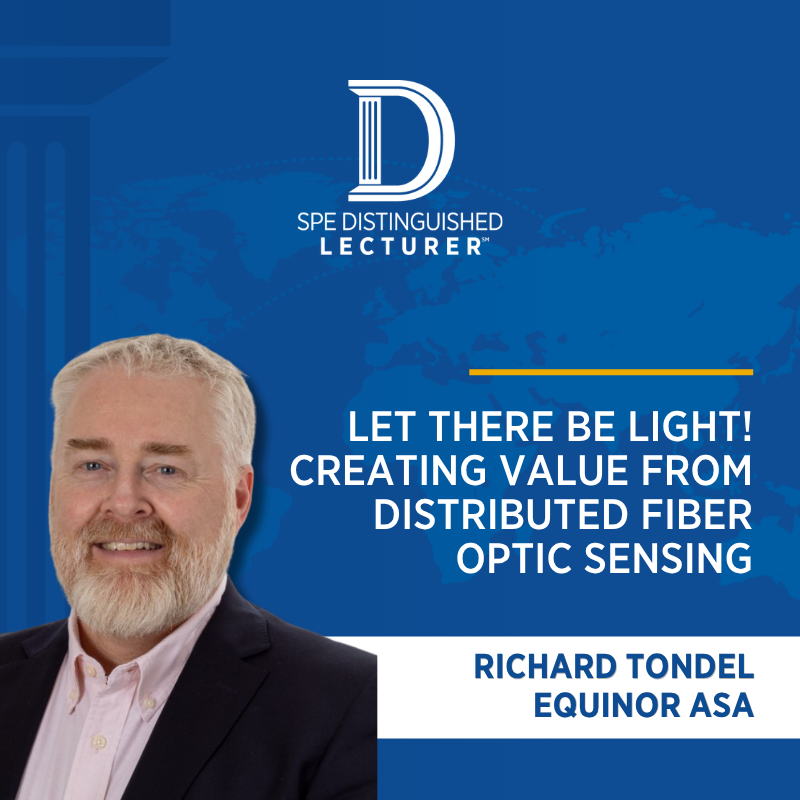
Richard Tøndel received his M.Sc. in Petroleum Geoscience from Norwegian University of Science and Technology (NTNU) and holds more than 25 years of industry experience. He has managed several research activities involving time-lapse seismic, permanent sensor systems, and in-well measurements. During the last 15 years, the fiber optic element of his work has become more pronounced, and he is now responsible for Equinor’s R&D fiber optic activities within subsurface. Tøndel was member of EAGE’s Distinguished Lecturer Program in 2007 and has received internal and external awards for his presentations. He has co-chaired annual European SPE fiber optic workshops in the period 2022 – 2026.
Section Evening Technical Programme Sponsor